
Explaining Jreg: Autism-Schizophrenia Horseshoe Theory
iterating on jreg's ideas about the dialectical nature of autism and schizophrenia

This multi-part essay is the product of a three-year long preoccupation with autism and schizophrenia that started around the time youtuber and internet satirist Jreg posted a video titled “Autizmophrenia: The Ultimate Neurodivergence” I literally jumped up and down as I saw the notification because autism and schizophrenia and their similar-but-opposite relationship had been bouncing around in my head like the DVD logo that always hits the corners because curvy shapes like the inside of my head have infinite (no corners) corners. Because Jreg’s video started my interest in the topic I will begin with his video, then move into various aspects of the relationship between autism and schizophrenia, then connect various aspects of schizophrenia to his content to describe its themes. Perchance.
Disclaimer: I’m literally just a neurotypical edgy teenager (20 year old ?? wtf??) with no formal education in psychology, neuroscience or any other of my pretentious sophomoric ramblings. Take all of this with a grain of salt. (A grain of salt is too much to take it with, you should probably take it with half a grain of salt (if you don’t have the dexterity to split a grain of salt you shouldn’t take it at all)).
A little bit of historical context for this. The term schizophrenia was coined in 1911 by the psychiatrist Eugen Bleuler to describe a condition that was formerly known in his as “dementia praecox” or a premature dementia, from the root “schiz” meaning “fragment” and “phren” meaning “mind.” Bleuler also coined the term “autism” to describe one of the symptoms of schizophrenia, the characteristic social withdrawal common to both our contemporary notions of autism and schizophrenia. On the other hand, what we would call autism today used to be referred to as “childhood schizophrenia” until psychiatrists recognized that these individuals did not develop positive psychotic symptoms in adulthood. The idea that autism and schizophrenia are connected or opposite is much older than Jreg. It was proposed by a few different researchers, most notably Crespi and Badcock, to be discussed later.
My project in this essay is different from Jreg’s project in the autismophrenia video. Jregs’s video referred mainly to the slang terms “autistic” and “schizophrenic” as used as 4chan pejoratives or non-clinical descriptors for people. I am seeking to elucidate details of the extremes of human cognition as drawn from clinical cases and research and draw connections to our postmodern condition. In his words, I’m going to be extremely autistic about this. This goes further than Jreg’s surface level lateral connections between the two conditions, and because Jreg constantly innovates, it’s up to his fanbase to iterate his ideas. I gotta build out the tower from the bottom-up. There’s so many more details to consider. So let me show you how deep the rabbit hole goes.
Intro: Verticality vs Laterality
Autizmophrenia rolls off the tongue better and is Jreg’s video title but I like schizo-autism because I am in a queer-platonic situationship with hyphens (and also because the root schiz is more relevant than the root phrenia).
In order to talk about this, I first have to talk about schizotypy. Schizotypy1 is a construct devised to explain the sorts of abnormalities you would see in the family members of people with psychotic disorders, but not full-blown psychosis, or to describe characteristics associated with a predisposition to psychosis. Schizotypy can also be viewed as a spectrum from small perceptual abnormalities, social withdrawal, anhedonia (loss of pleasure), magical thinking, to full blown psychosis. According to the 2024 review of schizophrenia research2, the scientific consensus around schizophrenia is shifting to acknowledging that schizophrenia is such a varied condition that it would be more accurate to characterize schizophrenia as a multi-dimensional spectrum or collection of similar disorders. The schizophrenia spectrum disorders include schizophrenia, schizoid and schizotypal personality disorders, schizoaffective disorder, bipolar with psychotic features, and psychotic depression.
The scientific consensus about autism is that it's also a spectrum. Not just mapped on one dimension, as in less autistic to more autistic, but more accurately a multidimensional spectrum construct with aspects clustered together such as difficulties with social cognition, sensory issues, repetitive movements and special interests. One particular individual may have more or less sensory issues and more or less issues with social reciprocity.
Autism and schizophrenia have several aspects that seem to be opposite, but due to their distance from neurotypicality, result in the same deficits. A few researchers have observed this connection, describing autism and schizophrenia as diametrically opposed. Crespi and Badcock (what a name for a sociology professor imagine the jokes his students would make about him) theorize that maternal and paternal gene imprinting contributes to higher risks of autism or schizophrenia.3 They argue that deficits in autism correspond to “hypertrophied” versions of the same dysfunctions in psychosis. For example, an autistic person may struggle to discern when someone is romantically attracted to them, while a person experiencing delusions in psychosis might experience erotomania, or the delusion that everyone is in love with them.
Here’s the thing about opposites. True opposites don’t really exist. Light and dark are both about light, good and evil are both about morality, man and woman are both about gender, and thus opposites are similar, due to being mapped on the same axis, on the same plane, diameter-ically opposed into the same circle. The same is true for autism and schizophrenia. It’s embedded in our figurative language too, like the phrase “two sides of the same coin.” How do we re-present this? It’s our good friend, the horseshoe! This is also how Jreg depicts the relationship in his video thumbnail. The two extremes have more in common with each other than the center.
What do autism and schizophrenia have in common? They are both maladaptive neurological disorders that can also serve as a metaphor for maladaptive cognition. Jreg’s video primarily concerns the vertical vs. lateral thought. Jreg relates the autism to schizophrenia spectrum as related to what he calls depth vs. width and verticality vs. laterality. Jreg defines lateral thinking as drawing connections between concepts that seem unrelated, and vertical thinking as knowing everything about a particular subject. This is a terrible metaphor for these two styles of cognition because they presuppose maladaptation, which is why they are derogatory 4chan slang.
By using these terms, Jreg and I are both attempting to define the “core symptom” of both autism and schizophrenia. His terminology mirrors Bleuler’s conception of schizophrenia as a disorder of loosened associations, whose attempt to understand the core of the condition he coined is shelved away to outdated psychiatric history. Decades later, we have knowledge of the hundreds of genetic markers for schizophrenia risk from mapping the human genome, knowledge of the neurobiology of schizophrenia from MRI studies and knowledge of the internal experience of schizophrenia from first hand accounts. But we don’t know how these connect. The 2024 research review invokes the previous 2014 research review of schizophrenia that invokes the parable of the six blind men of Hindustan feeling different parts of an elephant. One touches the trunk and thinks it’s a snake, another touches its ear and compares it to a fan, and another feels its leg and believes it is like a pillar. This is an attempt to talk about the elephant in the room.
In his video Jreg proposed that “schizophrenia at its core, is uncontrolled lateral moves.” I believe that this is somewhat true but reductive; the core of schizophrenia is an inability to place oneself within the shared cultural context of consensus reality. Being there but not really there. Uncontrolled lateral moves are a symptom of this contextual collapse.
One thing Jreg got really wrong about the relationship between autism and schizophrenia is that he contrasts a specific situation in which an autistic person senses a small difference in their environment and believes it to be completely different and contrasts it with lateral moves in schizophrenia. These aren’t opposites! This experience and heightened sensory input is actually shared between autism and schizophrenia.
Take the famous example of Capgras' delusion. A man comes home to his wife and his perceptual systems that are supposed to handle noise fail, so something just seems a little “off” about her. He starts to believe that she is an imposter pretending to be his wife. This is analogous to the example Jreg gave for autism; someone moves a chair around in the kitchen and the autistic person freaks out cuz it’s like a whole different kitchen. The better way to explain perceptual differences between autism and schizophrenia that result in the same deficits is the contrast between the concepts of “aberrant salience” and “aberrant precision.”
Aberrant Salience vs. Aberrant Precision
One commonly accepted theory for why delusions of reference (the delusion in which someone believes that something refers directly to them) is that particular aspects of the visual field become unusually salient. This is usually attributed to excesses of dopamine. According to the aberrant salience hypothesis4, delusions of reference develop because the brain reaches for explanations for this salience. For example, someone might become hyper-focused on street signs (aberrant salience) and then start to believe that the “No Ped Xing” street sign is telling them that there are no more Chinese villages because their thoughts passed through the souls of their feet and caused rifts in the fault lines (their fault) on the other side of the Earth (delusion of reference (see also the two-factor theory of delusion)).
On the other hand (unfortunately I have only two hands) a couple researchers who tried to define the core symptom of autism came up with a concept they called “aberrant precision” The theory follows that autistic people’s perception is overly precise, so they are not able to ignore the noise that most neurotypical people ignore. An autistic person’s perceptions are intensely precise so that they feel the flickers of the fluorescent light, the seams of their socks and the clothing tag against their neck. Autistic people have trouble with social interaction because people are complex and interacting with people is like a flood of information. Autistic people stim and have special interests because these stimuli are predictable. Autistic and schizophrenic people generally share this issue with what Jreg calls “noise.” Their perception is noisier but for different reasons.
I was first introduced to the idea that autism and schizophrenia might be connected by this essay by Scott Alexander. He’s this rationalist self-described-scientismist psychiatrist and in his essay It’s Bayes All The Way Up5 he argues that autism and schizophrenia are both failures of the handshake between top-down priors and bottom-up sensory data. (I was top-down bottom-up with your mother last night btw) He uses this framework called Bayes’ Theorem, a statistical formula that takes prior information you know, and new information, and integrates the new information into the prior information adjusting it accordingly. He cites a 2009 study that theorizes that glutamate (the most common neurotransmitter in the brain) modulates these systems, associating the bottom up processing with glutamate binding to AMPA receptors in the brain and the top down processing with glutamate binding to NMDA receptors. (hmmm I wonder what other jreg-related context the terms “bottom-up” and “top-down” are used for…)
It’s funny cuz Jreg joked that the psychiatrists haven’t figured it out yet, only him and then in the next breath cites a study about fetal early stage quick inflammation leading to autism risk and prolonged inflammation leading to schizophrenia risk. (which he says makes sense because you’re born with autism early on but you develop schizophrenia later on (Hence when I was 14 and had no friends and thought everyone could read my mind through my hands and was hiding it from me, I read Scott Alexander’s essay It’s Bayes All the Way Up and now I write pretentious bullshit connecting my lifelong casual interest in autism and my three year long intense obsession with schizophrenia. (I promise I’m neurotypical I promise. (The inability to tell other people’s intentions leads to an idiosyncratic way of understanding other people’s intentions (Horseshoe theory())))))
Anyways, in his video on psychosis, Jreg makes this distinction between “doubling down” and “breaking down.” This distinction roughly maps onto top-down and bottom-up processing. To double down is to apply a top-down framework across a lateral landscape of seemingly unrelated concepts even when it doesn’t look like it fits to most people, and to break down is the break down of these concepts into noise, debris, pieces of concrete with no connections. Anything that breaks the frame.
There’s this particular paradox that has always bugged me about studies of cognitive styles in schizophrenia. Schizophrenic cognition is portrayed as noisy, chaotic and abstract, but at the same time overly structured and concrete. (I intuit that this is also the unorthodox distinction that Deleuze and Guattari make between the schizophrenic and the paranoiac) The answer is both. More noise, more rigid frameworks to compensate for the noise. It’s a dialectic. The abstract collapses into the concrete. The psychoanalyst Silvano Arieti, in his influential but outdated book Interpretations of Schizophrenia6 characterized schizophrenic cognition as a process of active concretization, displacing the anxiety-provoking and disintegrating material of the abstract, into the concrete.
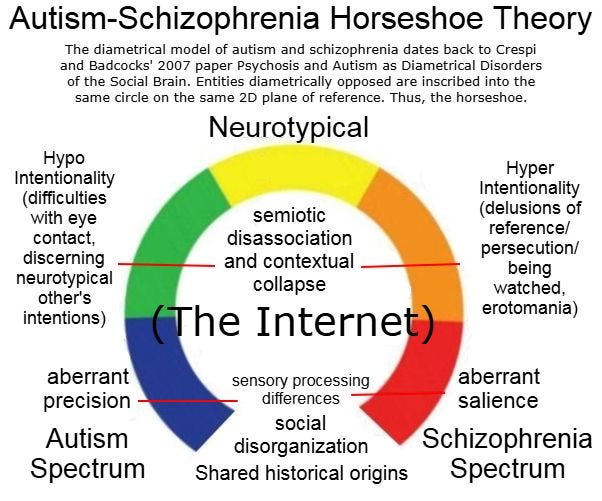
The most noisy and chaotic situations in our environment are those that involve other people. Which brings me to my next point of comparison, how autism and schizophrenia affect the perception of irony, context, and the minds of other people.
Irony: Contextual Collapse and Theory of Mind
Neurotypicals are mind readers.
The perception of irony requires two crucial aspects, both of which are impaired on the internet due to the nature of online communication: context and theory of mind. These two abilities are also impaired in autism and schizophrenia, taking context into consideration and the ability to estimate what is in the speaker’s mind, in order to discern if it is the opposite. We call the ability to guess what’s in another person’s mind “theory of mind.”
By the way HUGE disclaimer what I am NOT saying is that either autistic or schizophrenic people are incapable of realizing that other people have minds and understanding that other people have feelings. Theory of mind is controversial for this reason, but here, I use it to mean the ability to play the neurotypical guessing game of figuring out neurotypical people’s thoughts and feelings.
Another name for “theory of mind” is mentalization. To map mentalization onto the schizo-autism spectrum, autistic people tend towards hypo-mentalization and psychotic people tend towards hyper-mentalization.7 Some autistic people have trouble discerning neurotypical people’s internal states based on their expressions and behavior. For example, not noticing that someone is signaling that they are not interested through their body language and affect. Conversely, some people experiencing psychosis over-interpret small gestures to mean that people are out to get them, or that small flickers of eye contact to mean that people can read their mind.
Another name for “theory of mind” is mind-reading. Coincidence? I think not.
Jreg’s entire channel employs a bizarre blend of sincerity, irony, and sincerity through irony. His most famous series Centricide can either be taken as a critique of centrism or a critique of political extremism. Jreg’s persona is so ambiguous yet intolerant of ambiguity that it might constitute an expression of ambivalence, another measure of schizotypy. Ambivalence was first described by Eugene Bleuler as a symptom of schizophrenia, along with autism, ambitendency, and abnormal affect. It is correlated with measures of schizotypy.8 A quote from Frameworthless: “You could also look at it as the attempt at a genuine framework, an exercise for the schizotypal. Culturally we are going through the same process of disintegration and reintegration that schizotypals wrestle with their whole lives.”
We currently live in a world dominated by competing meta-narratives. Jreg’s intense ambivalence is an expression of this confusion. The ambivalence can be interpreted as an expression of his own mental state (example: Stop Asking if I’m Okay || Centricide 7), or as a commentary on how varied the audience’s interpretation can be, an extension of the critique of political polarization (example: Amazon™ Crowbar (yeah jreg, you show those [OUTGROUP] who’s boss!)). The loss of self-identity that Jreg expresses is common to a plethora of varied mental health symptoms and mental illnesses; you could interpret the ambivalence as self-disorder in schizophrenic spectrum conditions, or as an instability of identity found in disorders like borderline personality disorder, or as disasociation found in post-traumatic disorders. All of these conditions are more similar to each other than they are different.
To explain the connections between autism and schizophrenia, we need to first think about why horseshoe theory is sometimes true. Jreg’s channel and his podcast is based around the “horseshoe theory” because he has one of the weirdest fandoms on the internet. It is the one of the only places on the internet where people on all vertices of the 100-dimensional political hypercube can commune. It seems like the only thing they have in common is being fans of Jreg, but that’s not all, they’re too extremely online. That is to say, they’ve lost context, like the tweet from the meme from the GIF from the clip from the show Succession.

The layered analogy that Jreg is making is one that likens political polarization to the experience of internal conflict (whether it be in the form of disasociation, identity disturbance, or self disorder), but making this analogy is the act of subordinating one’s identity and belief system to others. Speaking of identity and belief systems, both are disrupted in schizophrenia and within the cultural context of chronically online internet sludge, which brings me to my next point.
Conspiracy, Confabulation, and Being Chronically Online
One last theory about the core symptom of schizophrenia is ipseity disturbance, also called self disorder, which is the instability of the minimal self sometimes characteristic of schizophrenia. The minimal self is this tacit assumption that your thoughts are your own, your body is your own, and your experience is your own. Disruptions of the minimal self lead to delusions of control or mind reading or thought broadcasting, or other psychotic experiences that confuse internal and external content. I experience this grass as green. The “I” in the statement is tacit and unquestioned, the focus is the object of experience. But in self disorder, the subject stops experiencing the world and starts experiencing experience itself. Researcher Louis Sass, most famous for his book connecting aspects of schizophrenia to artistic tendencies within modernism and postmodernism, used the term “hyperreflexivity” to describe this alteration within experience. It bears similarities to the digitized way that autistic people learn neurotypical norms, through isolated analysis, digitized conscious and careful reflection instead of intuition, like a pixellation approaching an organic shape. Both are ways of interpreting the instability of identity that marks Jreg’s content and the postmodern condition.
The Center Cannot Hold! When Jreg yells out this statement in his satirical political rally it is a reference to political polarization and postmodern fragmentation and his philosophy of “anti-centrism” a meta-ironic critique of either centrism or extremism depending on your perspective. It may or may not be a reference to Professor Elyn Saks’s memoir The Center Cannot Hold: My Journey Through Madness.9 Saks is a law professor from USC who lives with schizophrenia and advocates for the rights of schizophrenics. The title comes from the first part of the book where Saks is describing an experience of what she calls “disorganization” and Sass later references this to support his theories about self disorder.
“The center cannot hold. The "me" becomes a haze, and the solid center from which one experiences reality breaks up like a bad radio signal. There is no longer a sturdy vantage point from which to look out, take things in, assess what's happening. No core holds things together, providing the lens through which to see the world, to make judgments and comprehend risk.”
This experience in which there is no coherent framework with which to view reality is eerily similar to our current post modern post truth situation. The Overton Window is undergoing mitosis, being pulled apart from inside. Much political discourse is no longer about the clash between moral ideals or means to achieve those ideals, it is instead a fundamental disagreement along the material axis of consensus reality. The lenses through which people see the world are expanding because they are made of glass and glass expands when it gets too hot. The dizzying centrifugal forces of the earth (global warming) will accelerate the particles in those glass lenses of the Overton Window unevenly until the center shatters.
In other words, politics is schizophrenizing. As Deleuze and Guattari said, capitalism is a schizophrenizing force. I think if they were alive today they would consider the internet as a schizophrenizing force. It decontextualizes, or in D&G’s terminology deterritorializes, takes lines of flight from the self to the social and political and historical.
It’s so Joever. All knowledge must now be narrative knowledge.
There’s this other study that concluded that schizophrenic experiences are a result of the hyperactivity of the parts of the brain responsible for narrative creation, focusing on confabulation.10 The article defines it as the “side-effect of an interpretive faculty that makes sense of the world by rationalising our experience within the context of a personal and cultural narrative.” Jreg’s content is primarily concerned with extremes. This is a meta-extreme; it is the extreme of narrativity, which is why it resembles schizotypy. It is the antithesis to the loss of narratives that defines the postmodern condition. Louie Sass is also famous for likening the experience of schizophrenia to the tendencies within modernist and post-modernist art, literature, and philosophy.
Why did he compare the experience to modernist and post-modernist at the same time? Oh look it’s our ex-girlfriend the horseshoe! Nevermind, that’s a terrible metaphor. Both of them, tfw no gf and tfw no good metaphor for the unity of opposites. In the words of our lord and saviour Jregus Jrist, “this is just dialectics for edgy teenagers.” The “incredulity towards metanarratives” that characterizes the postmodern condition collapses (or is sublated if you wanna be fancy and hegelian) into the safety of a singular narrative. *Cough, cough.* And so the entire channel is a series of these collapses into concretion, into a narrative, into a the individual experience of a single well-defined character.
Conclusion: Touching Grass
[to the tune of Femininomenon by Chappell Roan] “But what we really need is a- Phenomenology! A what? A phenomenology!”
Phenomenology is the philosophical study of experience, theorizing about how the way we look at the world changes the philosophical conclusions we arrive at. The only way to know what the experience of psychosis is like is to talk to many different people who've struggled with it cuz it's different for everyone. This is the limitation of science and especially psychology, it works through generalization and replication but people and psychosis are hard to generalize. This is why throughout this essay I have cited research about the internal experience of autism, schizophrenia, and psychosis. Researchers like Louis Sass take a phenomenological approach to psychosis, providing analogies to help people understand the experience of psychosis.
There’s this Lacanian paradox at the heart of any writing on psychosis. Language operates within the realm of what Lacan called the Imaginary (images) and the Symbolic (words). Psychosis as a rupture into the Real, into what cannot be expressed through the Imaginary and the Symbolic, unimaginable and unsymbolizable. In every written account of psychosis I read, the author mentions that their experience is difficult to put into words. They tried anyway, and the work I am reading is the result. This is what draws me to writing on psychosis.
I myself am a cognitive centrist [And the crowd gasps in horror!] and I think the sexiest insights are drawn from connections between levels of abstraction (the intersection between vertical and lateral thought). 2024 is the year of not falling out of coconut trees and instead existing in the context of all that which came before you. (author’s note: I began writing this before the summer before the 2024 election when this meme was popular and due to my nearly pathological failure to finish big projects, have abandoned it until now. I guess 2025 is the year of being forced to exist in the context due to the external political climate.)
The context is this grass right here. Touch it.

What the fuck were you thinking? That’s not grass, that’s an image of grass.
Jreg’s video came from deep in Jrera2 where jreg was hyper-ironically advocating for mental illness and telling people they should try to be more autistic and schizophrenic. We’re in Jrera3? Jrera4? right now and this jrera is about defeating atomization and building community. Schizophrenia alienates people from any sense of community they had. So instead be a pan-cognitivist. Every single mode of cognition is important for the full understanding, and so every single person has something to contribute. Everything is it’s own center, so there is no center. The center cannot hold, but together, a community of people can.
So now I ask all the other people with a special interest in psychosis. What did I miss? What did I get wrong? For anyone on the autism spectrum or the schizophrenia spectrum, did this resonate? And to everyone, go touch some grass, you’re probably gonna need it after this. Stay sane, my friends.
https://en.wikipedia.org/wiki/Schizotypy
https://www.sciencedirect.com/science/article/pii/S0920996423004279?casa_token=yXrSV3E6_iEAAAAA:nvwDYbUXxczunHv_x9o8pxp_fzddjpnnzNLq6XtEI2Zr2kJBC8n5XXrUfj2ENK30rjqLxvBDOg
https://eprints.lse.ac.uk/21571/1/Psychosis%20and%20autism%20as%20diametrical%20disorders%20of%20the%20social%20brain%20(LSERO).pdf
https://psychiatryonline.org/doi/full/10.1176/appi.ajp.160.1.13
https://slatestarcodex.com/2016/09/12/its-bayes-all-the-way-up/
https://archive.org/details/interpretationof00arie
https://pubmed.ncbi.nlm.nih.gov/25210055/
https://pmc.ncbi.nlm.nih.gov/articles/PMC9332178/
https://archive.org/details/centercannothold0000saks_l5c4
https://link.springer.com/article/10.1007/s11245-018-9609-6
I wanted to say something cool and intelligent about the essay but instead i’ll say i love your writing 😄 it felt like a conversation and the jokes sprinkled in gave my brain a break. “(if you don’t have the dexterity to split a grain of salt you shouldn’t take it at all)).”- i think i rawdogged the article too hard and need to read it again with a corpuscle of salt because i know very little about the subject!
This was an entertaining read! As someone with level 1 ASD who had a multi year long psychotic break at 18 I want to add my experience to add to this point:
"The minimal self is this tacit assumption that your thoughts are your own, your body is your own, and your experience is your own."
One of the major delusions I had during my episode of psychosis was that I was a parasite (a Baldur's Gate worm it you will) in a literal sense. I thought that I had killed the prior host of the body I was in and was extremely paranoid that everyone would find out. I had zero emotional attachment to my loved ones and was intentionally trying to imitate the pre-psychotic-break self.
Ironically that delusion also functioned as a narrative explanation for how I experience life as an Autistic person. I spend a lot of time feeling detached from my humanity and imitating others to fit in with the "real" humans (neurotypicals). I fear people IRL finding out that I'm clinically weird and struggle to empathize or connect with others.
The hyper specificity of sensory input into my brain furthers this feeling that I am not me. I feel very intensely that my actual self (or the seat of my soul) is directly behind the center of my brow bone about two inches deep. I've felt this since I was a child. Which is interesting to me considering the amount of neuroscience research into dysfunction and connectivity of the frontal lobe in Autistic people. Because I have processing delays that effect motor control I often feel more like I'm in a faulty mecha meat suit then the owner of my own hands and feet. Like the differences in that part of my brain literally define my entire life.
It really is wild how similar my experiences of psychosis and my day to day life as and Autistic person have been. The mostly differ in how the (sensory/social) information is interpreted.
P.S. "diameter-ically" was funny af